

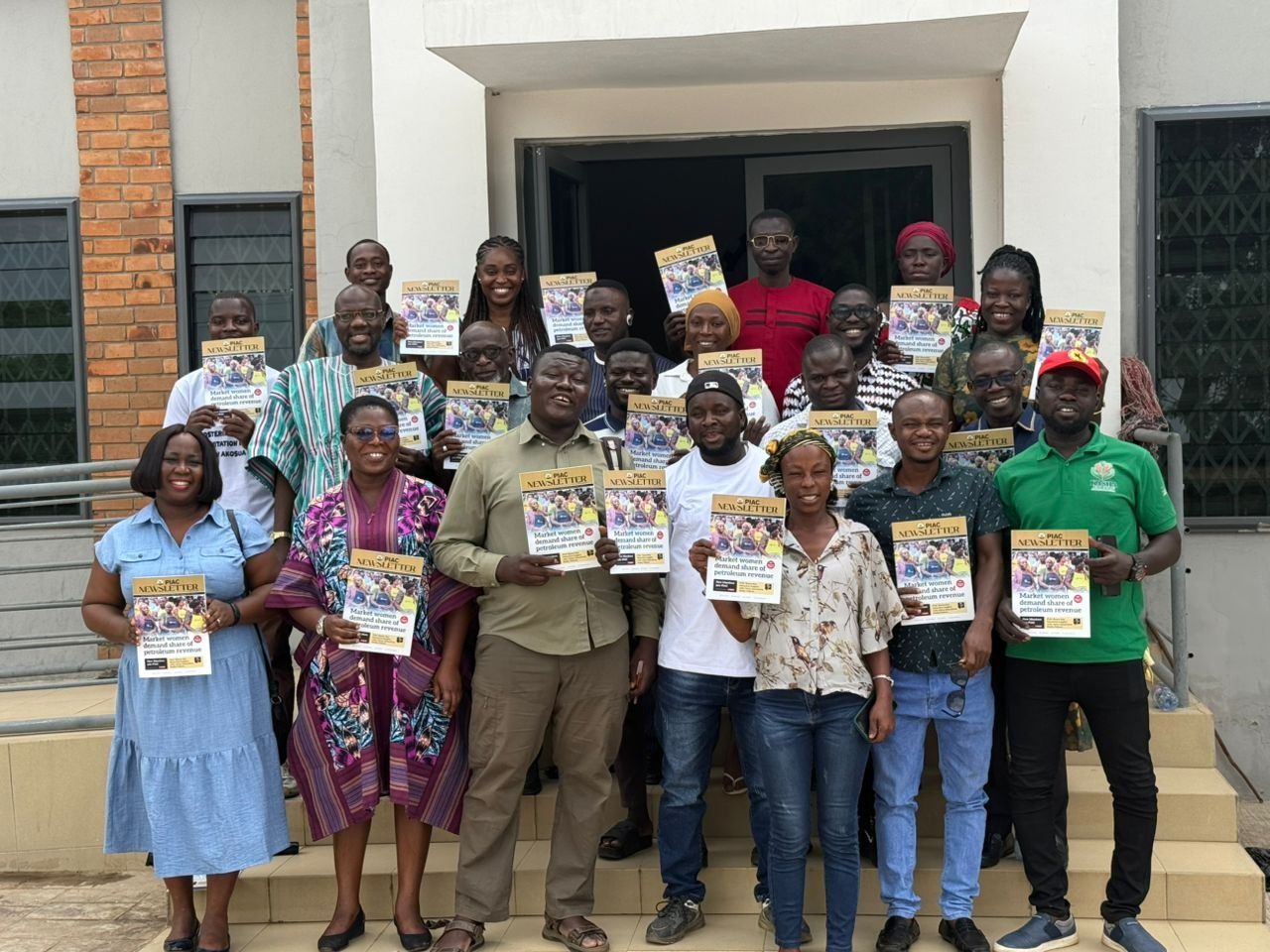
The conference room of the labour office in Damango, capital of the Savannah Region buzzed with quiet anticipation as journalists from across the area gathered for a capacity building workshop that promised to reshape their perspective on reporting on oil and gas.
The dry harmattan breeze, slipped through half-open windows, carrying with it the scent of dust and determination.
At the front of the training room stood Zambaga Rufai Saminu, Chairman of the Public Affairs and Communications Sub-Committee of the Public Interest and Accountability Committee (PIAC), ready to deliver a message he believed could transform oil and gas reporting journalism up north.
It was a Monday morning that felt different from the usual routine. Saminu had led a delegation of PIAC members to the region, a journey not merely of distance but of purpose.
The visit was part of a broader effort to engage media practitioners directly, to bring them closer to the realities and responsibilities tied to Ghana’s oil and gas sector.
As he began to speak, his tone was calm yet firm, carrying the weight of urgency.
He appealed to journalists to develop a deeper interest in oil and gas reporting, emphasizing that the sector remains one of the most critical pillars of the country’s economy.
According to him, the role of the media in shaping public understanding could not be overstated.
Many of the journalists listened intently, some scribbling notes while others nodded in quiet agreement.
For years, oil and gas had been treated as a complex and distant topic, often left to a handful of specialized reporters.
Saminu, an astute journalist and former Western Regional Secretary of Ghana Journalists Association (GJA) challenged that norm, urging every journalist in the room to see the sector as their responsibility.
He spoke passionately about transparency, describing it as the backbone of trust between the government and its people.
Without clear and accessible information, he noted, citizens would remain disconnected from decisions that directly affect their livelihoods.
The media, he insisted, must bridge that gap.
Accountability, he continued, was not just a principle but a duty.
Institutions managing petroleum resources must be held answerable to the public, and journalists serve as the watchdogs in this process.
His words carried a sense of conviction that resonated deeply with his audience.
Saminu also highlighted the importance of compliance with laws governing the petroleum industry.
He explained that these laws were designed not only to regulate activities but to protect national interests.
When adhered to, they ensure that Ghana’s resources benefit both present and future generations.
The delegation’s presence in the Savannah Region signaled a deliberate effort to decentralize knowledge and engagement. Too often, discussions around oil and gas remained confined to major cities, leaving regional journalists under-informed.
This visit sought to change that narrative.
As the session progressed, questions began to flow and commitment made by participants to improve relationship with PIAC .
The Journalists sought clarity on technical issues, funding transparency, and the role of PIAC in monitoring petroleum revenues.
The interaction turned the room into a lively exchange of ideas, reinforcing the very engagement Saminu had advocated.
By the end of the meeting, there was a noticeable shift in the atmosphere.
What began as a routine gathering had evolved into a call to action when the Northern Regional Chairman of GJA Yakubu Abdul Majeed challenged the reporters to create room for oil and gas reporting at their various media houses
Consequently, the Journalists left with a renewed sense of purpose, sincerely being made aware that their stories could influence not just public opinion, but national development itself.
Madam Sena Dake, former President of Institute of Chartered Accountants Ghana who is a member of the committee, and Isaac Dwamena, were main facilitators who carried out various presentations on the mandate of PIAC, and presented highlights of the 2025 PIAC Annual Report as part of the workshop.