



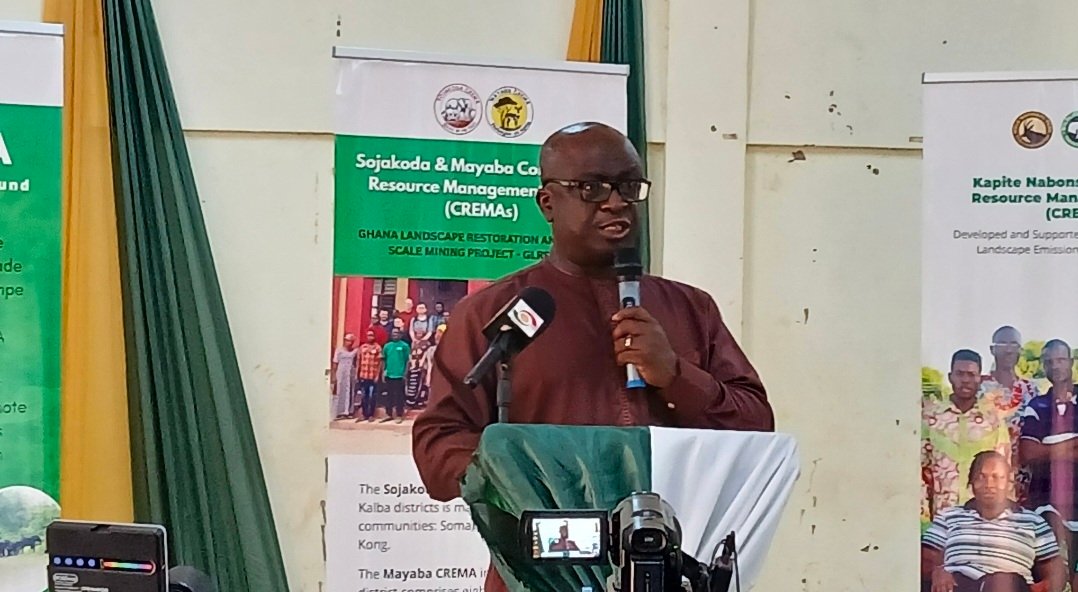
The Ghana Wildlife Society (GWS), in partnership with the Mole National Park and the Royal Society for the Protection of Birds (RSPB), has officially inaugurated the Kananto-Kabampe Community Resource Management Area (CREMA) a landmark conservation initiative in the Savannah Region aimed at placing local communities at the heart of wildlife and natural resource management.
The inauguration ceremony, which also marked the establishment of three other CREMAs, was attended by the Honourable Minister of the Savannah Region, a representative of the Yagbonwura, the Executive Director of the Wildlife Division of the Forestry Commission, community leaders, and members of the Kananto and Kabampe communities.
Speaking at the occasion, Professor Erasmus H. Owusu, Council Board Member and Acting Executive Director of the Ghana Wildlife Society, said the decision to support the CREMA was guided by a core belief that conservation is most effective when communities lead it.
“Conservation works best when local communities are at the centre of it,” Prof. Owusu said, underscoring GWS’s commitment to building conservation frameworks that survive beyond project timelines.
The Kananto-Kabampe CREMA covers lands and ecosystems situated between the Kenikeni Forest Reserve and the Mole National Park a corridor that supports wildlife, sustains livelihoods, and maintains deep cultural ties between the communities and nature.
The initiative is backed by funding from the Ecological Restoration Fund (ERF) under a project titled “Enhancing Habitat Conditions and Ecosystem Services to Improve Ecological Connectivity in the Southern Biodiversity Corridor,” which seeks to support the sustainable management of the Mole Ecological Landscape.
Prof. Owusu acknowledged that the road to the inauguration was not without difficulties. An initial plan that included Larabanga, Kananto, and Kabampe failed, but he expressed encouragement at the perseverance and cooperation demonstrated by the people of the two remaining communities.
Among the key milestones already achieved is the successful planting of over 5,000 native tree seedlings, carried out with the active involvement of both communities, as well as biodiversity surveys conducted using bioacoustics techniques.
Prof. Owusu called on all stakeholders including community leaders, youth groups, traditional authorities, government institutions, and development partners to sustain their support for the CREMA. He emphasised the importance of upholding the initiative’s by-laws and policies, describing them as the foundation for protecting the future of the landscape.
He also appealed to NGOs and other partners to provide continued livelihood training, environmental education, and awareness creation to empower communities with the skills and knowledge needed for sustainable natural resource management.
“Today is not the end of a process, but the beginning of a new future,” Prof. Owusu said, urging all parties to work together to ensure that the benefits of the CREMA are shared equitably among community members.
The Ghana Wildlife Society reaffirmed its long-term commitment to supporting community-based conservation efforts across Ghana, expressing confidence that the Kananto-Kabampe CREMA would serve as a model for similar initiatives in the country.