


Mole National Park and partners have Inaugurated SOJAKODA, MAYABA, KK, and KAPITE NABONSE Community Resource Management Areas (CREMAs)
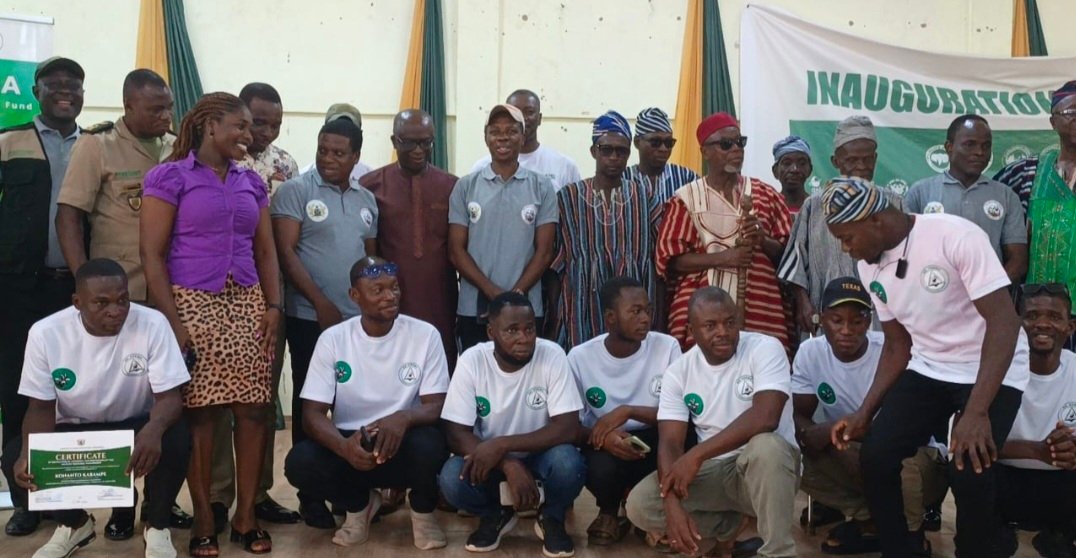
The ceremony, held on March 11, 2026, at the Damongo Community Center in Damongo, brought together government officials, traditional leaders, community representatives, and conservation partners from across the Savannah Region.
Community Resource Management Areas (CREMAs) remain one of Ghana’s most effective community‑based models for natural resource governance, promoting biodiversity conservation, sustainable land use, and improved livelihoods. Under the leadership of Mole National Park and the Wildlife Division of the Forestry Commission, several communities within the Savannah landscape have undergone institutional strengthening, stakeholder engagement, and governance processes, leading to the establishment of four functional CREMAs. These include SOJAKODA and MAYABA CREMAs supported by the Ghana Landscape Restoration and Small‑Scale Mining Project, KK CREMA supported by the Ecological Restoration Fund, through the Ghana Wildlife society (GWS), Management of Mole National Park, Traditional Authorities, and other Stakeholders, and KAPITE NABONSE CREMA supported by the Ghana Shea Landscape Emission Reductions Project.
Dr. Joseph Boakye, Executive Director of the Wildlife Division, emphasized that the future of natural resource management in Ghana depends on active community participation. He noted that government alone cannot manage all natural resources effectively, and that the people who live close to these resources and rely on them for their livelihoods must play a central role in their protection. Dr. Boakye highlighted that the CREMAs are part of broader initiatives supported by the Ghana Landscape Restoration and Small-Scale Mining Project, the Ecological Restoration Fund, and the Ghana Soil Emission Reductions Project to promote landscape restoration, strengthen climate resilience, conserve biodiversity, and improve community livelihoods.
Yakubu Yussif Castro, Municipal Chief Executive for the West Gonja Municipal District, described the CREMA initiative as a progressive approach to conservation, recognizing local communities not merely as beneficiaries but as custodians and partners in resource management. He noted that the project involves communities across West Gonja, North Gonja, and Sawla-Tuna-Kalba districts and will help restore degraded landscapes, promote sustainable livelihoods, protect ecosystems, and ensure equitable sharing of conservation benefits. Hon. Castro also commended traditional leaders, community members, wildlife authorities, civil society organizations, and government partners whose collaborative efforts made the CREMAs possible.
Moses Anagura, Northern Regional Park Manager of the Wildlife Division overseeing wildlife parks across the five northern regions, explained that the Community Resource Management Area concept, introduced around 2000, has been strengthened and formally recognized under the Wildlife Resources Management Act. He added that the initiative empowers local communities with both the authority and responsibility to sustainably manage natural resources, as part of broader conservation efforts linked to Mole National Park, Ghana’s premier national park.
Following the speeches, several individuals were honoured with citations for their contributions to conservation and community development around the park. Among those recognized were Chief Tolodompewura Abdalah Ahmed, Umaru Farouk Dubiure, and Mumuni Mohammed.
The four CREMAs inaugurated include the KK CREMA, funded by the Ecological Restoration Fund. Located in the West Gonja Municipal District, KK CREMA is made up of two communities — Kabampe and Kananto — working together to protect wildlife, conserve the environment, and promote responsible land-use practices that support both conservation and local livelihoods.
Other CREMAs inaugurated were the Sojakoda and Mayaba CREMAs under the Ghana Landscape Restoration and Small-Scale Mining Project (GLRSSMP). The Sojakoda CREMA in the Sawla-Tuna-Kalba District comprises four communities: Soma, Jang, Dabori, and Kong, while the Mayaba CREMA in the North Gonja District is made up of eight communities: Gbasimpa, Nabengu, Tingsungu, Kparia, Yagbon, Ziepe, Bugsah, and Sagiya. Both CREMAs promote collaborative environmental stewardship, sustainable land use, and biodiversity conservation.
Also inaugurated was the Kapite–Nabose CREMA, further strengthening community-led conservation initiatives around Mole National Park.
The inauguration of these four CREMAs marks a significant step in advancing community-led conservation, sustainable natural resource management, and improved livelihoods for communities surrounding Mole National Park.