



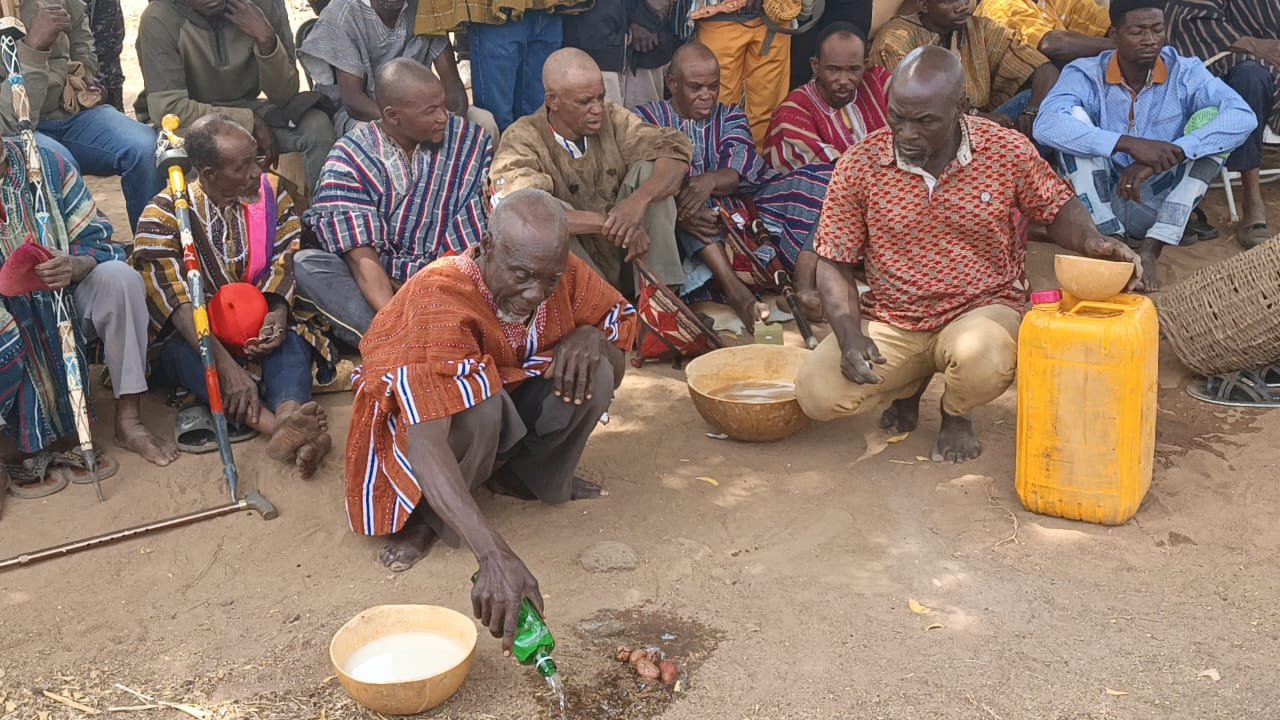
In a significant step toward lasting peace and reconciliation, traditional leaders and land priests in the Savannah Region have performed a series of traditional rites to cleanse the land and appease the gods and ancestors following the deadly Gbinyiri land conflict.
The rites, which were held on Friday, 23rd January 2026, were led by the Dagbigu Chief Priest, Heuhing Deleka, with the support of traditional leaders, elders, and land custodians from across the area.
The ceremonies formed part of traditional efforts to spiritually heal the land after the conflict, which resulted in loss of lives, displacement of families, and disruption of livelihoods in the Gbinyiri community and surrounding areas.
The first phase of the rites took place at Gbinyiri, where sacrifices were offered to cleanse the land of blood spillage believed to have spiritually defiled the community during the violent clashes. According to traditional belief, such bloodshed disturbs the balance between the living, the land, and the ancestral spirits, requiring purification rituals to restore harmony.

The second phase was held at Dagbigu, where further sacrifices were made to appease the gods and ancestors, seeking forgiveness, protection, and a permanent restoration of peace in the affected communities. Traditional authorities declared both rites successful, signaling spiritual acceptance of the offerings.
Speaking to the media after the ceremonies, the Chief Priest of the Tuna Area, Heuhing Mwiiri Kipo, expressed gratitude to the gods and ancestors for accepting the sacrifices and granting peace.
He described the Gbinyiri conflict as deeply unfortunate, stressing that its consequences went beyond the immediate violence. He noted that many families, particularly women and children were displaced from their homes, access to healthcare and education was disrupted, and large quantities of farm produce that were due for harvest were left to rot, worsening the economic hardship of affected households.
According to him, the successful completion of the rites represents a renewed commitment to peace and coexistence, and traditional leaders firmly believe that such a tragic incident would not recur.

However, Heuhing Mwiiri Kipo issued a strong warning, invoking ancestral authority against any individual or group that might attempt to reignite violence in the area. He cautioned that anyone who takes up arms, whether guns, cutlasses, or any other weapons to disturb the peace of Gonjaland would be left to the judgment of the gods and ancestors.
He emphasized that peace in the land is sacred and must be protected by all, adding that traditional sanctions remain a powerful deterrent against lawlessness and violence.
Also speaking to the media, Rev. Fr. Lazarus Annyereh, a member of the government-appointed Gbinyiri Conflict Mediation Committee and Savannah Regional Chairman of the National Peace Council, described the event as a moment of joy and renewed hope for the people of the area.

He commended the traditional authorities for their leadership, humanity, and commitment to peace, noting that traditional and modern conflict resolution mechanisms must complement each other to achieve sustainable peace.
Rev. Fr. Annyereh assured the public that the National Peace Council, working with other stakeholders, would continue to support efforts aimed at ensuring that peace in Gonjaland is not compromised.
He further noted that his presence at the rites as a Catholic priest demonstrated the Catholic Church’s respect for all faith traditions that promote peace and harmony. According to him, African Traditional Religion, like Christianity and Islam, plays a critical role in fostering peaceful coexistence and mutual respect among communities.

The rites were witnessed by chiefs from the Bole Traditional Area, security personnel, elders of the Brifors community, and members of the media, underscoring the broad stakeholder support for peace in the region.
The ceremonies marked a symbolic and spiritual closure to the Gbinyiri conflict, as the community looks forward to healing, rebuilding, and a future grounded in peace and unity.